11 posts tagged with "cloud security"

View All Tags

Identify Outdated TLS Versions in Azure with StackQL

Β· 2 min read
Technologist and Cloud Consultant

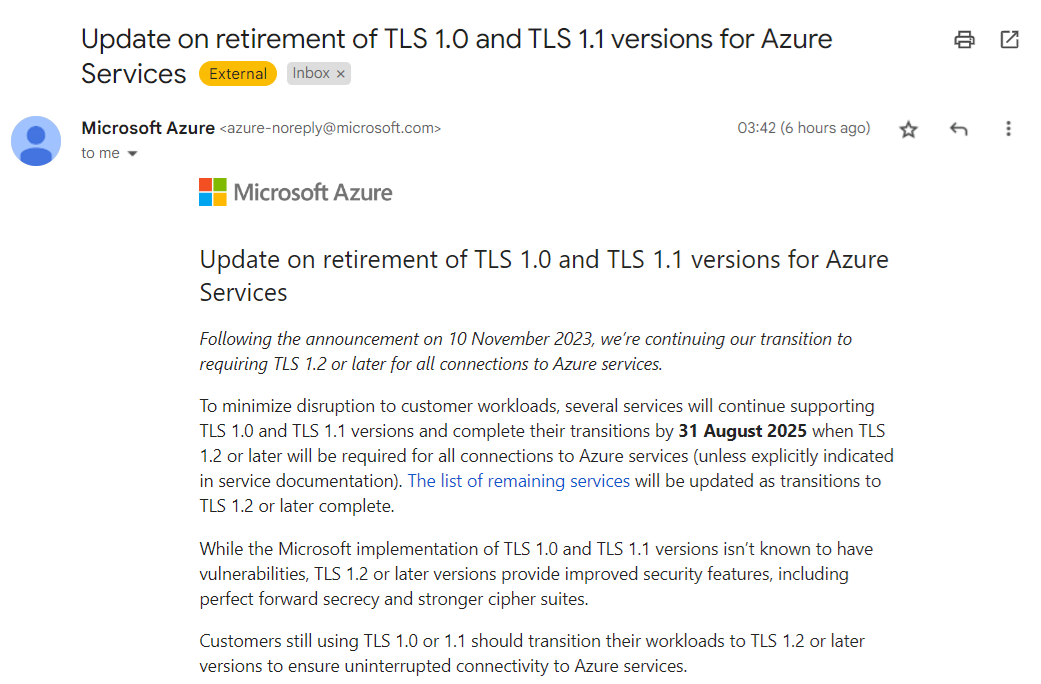
Have you received one of these?

Azure TLS Deprecation Email

Microsoft Azure is retiring TLS 1.0 and 1.1 for its services, requiring customers to transition to TLS 1.2 or later to ensure uninterrupted connectivity. If you have workloads still using older TLS versions, you’ll need to update them.

Using StackQL to Identify Non-Compliant Resources​

With StackQL, you can quickly identify resources in your Azure environment that are still using older TLS versions. This article shows how to leverage StackQL queries to check various Azure services for compliance.

Prerequisites​

  1. Pull the latest StackQL provider for Azure using REGISTRY PULL azure.
  2. Authenticate with Azure using StackQL by setting up your credentials as environment variables (or using your existing az login system/session authentication).

Queries to Run​

Below are example queries you can use to identify resources affected by the TLS 1.2 requirement (use your subscriptionId of course):

1. Check Application Gateway Configurations​

Azure Application Gateways may support older TLS versions. Run the following query to get their configurations:

SELECT
id,
name,
JSON_EXTRACT(properties, '$.sslPolicy') as ssl_policy,
JSON_EXTRACT(properties, '$.defaultPredefinedSslPolicy') as default_predefined_ssl_policy
FROM
azure.network.application_gateways
WHERE
subscription_id = '123e4567-e89b-12d3-a456-426614174000'
AND ssl_policy IS NOT NULL
AND JSON_EXTRACT(properties, '$.sslPolicy') NOT LIKE '%TLS12%';

This query lists all Application Gateways configured with TLS versions lower than 1.2.

2. Inspect App Service Configurations​

If you use Azure App Services (Web Apps), check their TLS configurations with this query:

SELECT
id,
name,
JSON_EXTRACT(properties, '$.httpsOnly') as https_only,
JSON_EXTRACT(properties, '$.siteConfig.minTlsVersion') as min_tls_version
FROM
azure.web.web_apps
WHERE
subscription_id = '123e4567-e89b-12d3-a456-426614174000'
AND JSON_EXTRACT(properties, '$.siteConfig.minTlsVersion') < '1.2';

This returns all web apps that allow connections using TLS versions older than 1.2.

3. Check SQL Server Instances​

Azure SQL Databases and SQL Managed Instances may also have TLS configurations that need checking:

SELECT
location,
fullyQualifiedDomainName,
minimalTlsVersion,
state
FROM
azure.sql.servers
WHERE
subscription_id = '123e4567-e89b-12d3-a456-426614174000'
AND minimalTlsVersion < '1.2';

This shows all SQL servers with a minimal TLS version set below 1.2.

We’d love to hear your feedback. ⭐ us on GitHub and let us know how StackQL helps you manage your Azure resources!

Delete Default AWS VPCs with StackQL

Β· 6 min read
Technologist and Cloud Consultant

AWS creates default VPCs in each region for convenience. However, these default VPCs often contain noncompliant network ACLs and security group rules that do not align with best practices for AWS Config and Security Hub. Deleting these default VPCs is beneficial, especially for regions not used by your organization or architectures that do not utilize a VPC. Β 

This guide demonstrates how to use StackQL to enumerate and delete all default VPCs and their associated resources in all AWS regions. Β 

What you need​

All you need to do is to install the pystackql package using:

pip install pystackql

Deleting resources will require a privileged AWS IAM user. You can do this from a terminal with the AWS_ACCESS_KEY_ID and AWS_SECRET_ACCESS_KEY environment variables set (and optionally AWS_SESSION_TOKEN set if you are using sts assume-role). Β 

You can also use the StackQL Cloud Shell Scripts, from within AWS Cloud Shell, to run authenticated StackQL queries using:

sh stackql-aws-cloud-shell.sh

How it works​

This example uses the awscc (AWS Cloud Control) provider. Cloud Control resources are read in two steps: a _list_only view returns the resource identifiers in a region, and the resource view returns the full properties for a single resource selected by its Identifier.

Default VPCs in AWS regions have a CIDR block of 172.31.0.0/16, before deleting anything, the program ensures it is not in use by listing the network interfaces in the region and checking whether any belong to the VPC:

SELECT id
FROM awscc.ec2.network_interfaces_list_only
WHERE region = '{region}'

If any resources are using the VPC (such as EC2, RDS, ELB/ALB, VPC attached Lambda functions, etc), it will skip these VPCs. Β Once determined that the VPC is not in use, all of the resources associated with the VPC must be deleted before the VPC itself can be deleted; this includes:

  • External Routes (awscc.ec2.routes)
  • Internet Gateways (awscc.ec2.internet_gateways)
  • NACLs (awscc.ec2.network_acls)
  • Subnets (awscc.ec2.subnets)
  • and then finally, the VPC (awscc.ec2.vpcs)

The default route table and default security group are deleted automatically when deleting the VPC

This is done by discovering the resources using StackQL SELECT queries and deleting them using StackQL DELETE queries, like:

DELETE FROM awscc.ec2.network_acls
WHERE data__Identifier = '{nacl_id}'
AND region = '{region}'

Complete code​

The following Python program uses StackQL to list and delete default VPCs and their associated resources (subnets, route tables, internet gateways, security groups, and network ACLs) across all AWS regions.

Get the complete code here
from pystackql import StackQL
stackql = StackQL()
stackql.executeStmt("REGISTRY PULL awscc")

def ensure_one_or_zero(resource_list, resource_name, region):
if len(resource_list) > 1:
raise RuntimeError(f"ah snap! multiple default {resource_name} resources found in {region}")
elif len(resource_list) == 0:
print(f"/* no default {resource_name} found in {region} */\n")
return False
return True

def get_resource(region, resource, identifier):
# fetch the full properties of a single Cloud Control resource by its identifier
rows = stackql.execute(f"""
SELECT *
FROM awscc.ec2.{resource}
WHERE region = '{region}'
AND Identifier = '{identifier}'
""")
return rows[0] if len(rows) else None

def find_in_vpc(region, resource, id_col, vpc_id):
# list all identifiers for a resource in a region, then keep those attached to the target VPC
matches = []
for row in stackql.execute(f"SELECT {id_col} FROM awscc.ec2.{resource}_list_only WHERE region = '{region}'"):
detail = get_resource(region, resource, row[id_col])
if detail and detail.get('vpc_id') == vpc_id:
matches.append(detail)
return matches

regions = [
'us-east-1', 'us-east-2', 'us-west-1', 'us-west-2',
'eu-central-1', 'eu-central-2', 'eu-west-1', 'eu-west-2', 'eu-west-3', 'eu-north-1', 'eu-south-1',
'ap-east-1', 'ap-south-1', 'ap-south-2', 'ap-northeast-1', 'ap-northeast-2', 'ap-northeast-3',
'ap-southeast-1', 'ap-southeast-2', 'ap-southeast-3', 'ap-southeast-4', 'af-south-1',
'ca-central-1', 'me-south-1', 'me-central-1', 'sa-east-1'
]

for region in regions:
# find the default VPC (CIDR 172.31.0.0/16, untagged) by listing VPCs then inspecting each
default_vpcs = []
for row in stackql.execute(f"SELECT vpc_id FROM awscc.ec2.vpcs_list_only WHERE region = '{region}'"):
vpc = get_resource(region, 'vpcs', row['vpc_id'])
if vpc and vpc.get('cidr_block') == '172.31.0.0/16' and not vpc.get('tags'):
default_vpcs.append(vpc)
if not ensure_one_or_zero(default_vpcs, 'VPC', region): continue
vpc_id = default_vpcs[0]['vpc_id']

# check if the VPC is in use
network_interfaces = find_in_vpc(region, 'network_interfaces', 'id', vpc_id)
if len(network_interfaces) > 0:
print(f"/* skipping deletion of default VPC ({vpc_id}) in {region} because it is in use */\n")
continue

print(f"/* deleting resources for default VPC ({vpc_id}) in {region} */\n")

# get the default route table for the VPC
route_tables = find_in_vpc(region, 'route_tables', 'route_table_id', vpc_id)
ensure_one_or_zero(route_tables, 'route table', region)
route_table_id = route_tables[0]['route_table_id']

# get the internet gateway from the default (0.0.0.0/0) route
default_route = get_resource(region, 'routes', f'{route_table_id}|0.0.0.0/0')
inet_gateway_id = default_route['gateway_id'] if default_route else None

# delete the default route
print(f"/* deleting default VPC routes in route table ({route_table_id}) in {region} */")
print(f"""
DELETE FROM awscc.ec2.routes
WHERE data__Identifier = '{route_table_id}|0.0.0.0/0'
AND region = '{region}';
""")

# detach the internet gateway
print(f"/* detaching default VPC internet gateway ({inet_gateway_id}) in {region} */")
print(f"""
DELETE FROM awscc.ec2.vpc_gateway_attachments
WHERE data__Identifier = 'IGW|{vpc_id}'
AND region = '{region}';
""")

# delete the internet gateway
print(f"/* deleting default VPC internet gateway ({inet_gateway_id}) in {region} */")
print(f"""
DELETE FROM awscc.ec2.internet_gateways
WHERE data__Identifier = '{inet_gateway_id}'
AND region = '{region}';
""")

# delete the network ACL
nacls = find_in_vpc(region, 'network_acls', 'id', vpc_id)
ensure_one_or_zero(nacls, 'network acl', region)
nacl_id = nacls[0]['id']
print(f"/* deleting default VPC NACL ({nacl_id}) in {region} */")
print(f"""
DELETE FROM awscc.ec2.network_acls
WHERE data__Identifier = '{nacl_id}'
AND region = '{region}';
""")

# delete the subnets
subnets = find_in_vpc(region, 'subnets', 'subnet_id', vpc_id)
for subnet in subnets:
print(f"/* deleting default VPC subnet ({subnet['subnet_id']}) in {region} */")
print(f"""
DELETE FROM awscc.ec2.subnets
WHERE data__Identifier = '{subnet['subnet_id']}'
AND region = '{region}';
""")

# delete the VPC
print(f"/* deleting default VPC ({vpc_id}) in {region} */")
print(f"""
DELETE FROM awscc.ec2.vpcs
WHERE data__Identifier = '{vpc_id}'
AND region = '{region}';
""")

run the program using:

python3 delete-all-default-vpcs.py > delete_default_vpcs.iql

to generate a StackQL script you can run as a batch using stackql exec or as individual statements in the stackql shell.

Conclusion​

Deleting default VPCs can help improve your AWS security posture by removing potentially noncompliant network configurations. This program leverages StackQL to automate the process, ensuring consistency across all regions.

Let us know what you think! ⭐ us on GitHub.

The 5 Minute Global AWS Inventory

Β· One min read
Technologist and Cloud Consultant

StackQL allows you to query and interact with your cloud and SaaS assets using a simple SQL framework. Use cases include CSPM, asset inventory and analysis, finops and more, as well as IaC and sysops (lifecycle management).

Using stackql and the aws provider (AWS Cloud Control provider for stackql), here's how you can query your entire AWS estate in real time (globally) and generate a simple report like this...

aws-inventory-example

Check out the code at AWS Global Inventory!

Visit us and give us a ⭐ on GitHub

Using StackQL in Native Cloud Shells in AWS, Azure and GCP

Β· 4 min read
Technologist and Cloud Consultant

StackQL allows you to query and interact with your cloud and SaaS assets using a simple SQL framework. Use cases include CSPM, asset inventory and analysis, finops and more, as well as our IaC and ops (lifecycle management).

The three major cloud providers all offer a built-in Linux shell for executing commands using their respective CLIs; in some cases, they come with tools like terraform pre-installed. They are pre-authorized with your credentials in the cloud console for the user you authenticated with.

Now you can easily use stackql - a unified analytics and IaC dev tool - in all major cloud providers' built-in shells, using cloud shell scripts packaged with the stackql Linux binary (available from v0.5.587 onwards).

StackQL is particularly useful for asynchronously querying across regions in AWS, projects in Google, or resource groups in Azure, which is challenging to do via the CLIs. For example:

SELECT region, COUNT(*) as num_functions
FROM aws.lambda.functions
WHERE region IN (
'us-east-1','us-east-2','us-west-1','us-west-2',
'ap-south-1','ap-northeast-3','ap-northeast-2',
'ap-southeast-1','ap-southeast-2','ap-northeast-1',
'ca-central-1','eu-central-1','eu-west-1',
'eu-west-2','eu-west-3','eu-north-1','sa-east-1')
GROUP BY region;

Additionally, you could authenticate to another provider from one cloud shell simultaneously and run multi-cloud inventory commands. For example:

SELECT
name,
SPLIT_PART(machineType, '/', -1) as instance_type,
'google' as provider
FROM google.compute.instances
WHERE project IN ('myproject1','myproject2')
UNION
SELECT
instanceId as name,
instanceType as instance_type,
'aws' as provider
FROM aws.ec2.instances
WHERE region IN (
'us-east-1','us-east-2','us-west-1','us-west-2',
'ap-south-1','ap-northeast-3','ap-northeast-2',
'ap-southeast-1','ap-southeast-2','ap-northeast-1',
'ca-central-1','eu-central-1','eu-west-1',
'eu-west-2','eu-west-3','eu-north-1','sa-east-1');

Getting Started​

To get started with StackQL in your preferred cloud shell environment, download the StackQL package using the following command:

curl -L https://bit.ly/stackql-zip -O \
&& unzip stackql-zip

This command downloads the StackQL package, unzips it, and sets the appropriate permissions. From there, you can use our tailored scripts for AWS, Google Cloud, or Azure to integrate StackQL seamlessly into your cloud shell environment.

Using StackQL in the AWS Cloud Shell​

Run the stackql-aws-cloud-shell.sh as follows to use the StackQL command shell within the AWS cloud shell:

sh stackql-aws-cloud-shell.sh

An example is shown here:

aws-cloud-shell-example

You can also run stackql exec commands using the stackql-aws-cloud-shell.sh script; for instance, this command will write a CSV file for the results of a query that could be downloaded from the Cloud Shell.

sh stackql-aws-cloud-shell.sh exec \
--output csv --outfile instances.csv \
"SELECT region, instanceType FROM aws.ec2.instances WHERE region IN ('us-east-1')"

Additionally, you can supply an IAM role using the --role-arn argument to assume another role for your query or mutation operation, an example is shown here:

sh stackql-aws-cloud-shell.sh \
--role-arn arn:aws:iam::824532806693:role/SecurityReviewerRole exec \
--infile query.iql \
--output csv --outfile output.csv

Using StackQL in the Azure Cloud Shell​

Run the stackql-azure-cloud-shell.sh as follows to open a StackQL command shell from the Azure Cloud Shell:

sh stackql-azure-cloud-shell.sh

An example is shown here:

azure-cloud-shell-example

Similar to the AWS script, you can also invoke stackql exec as well, an example is shown here:

sh stackql-azure-cloud-shell.sh exec \
--output csv --outfile instances_by_location.csv \
"SELECT location, COUNT(*) as num_instances FROM azure.compute.virtual_machines WHERE resource_group_name = 'stackql-ops-cicd-dev-01' AND subscription_id = '631d1c6d-2a65-43e7-93c2-688bfe4e1468' GROUP BY location"

Using StackQL in the Google Cloud Shell​

Run the stackql-google-cloud-shell.sh as shown below to launch a StackQL command shell from within the google cloud shell:

sh stackql-google-cloud-shell.sh

An example is shown here:

google-cloud-shell-example

As with the other two providers, you can run exec commands following the example below:

sh stackql-google-cloud-shell.sh exec \
--output csv --outfile instances.csv \
"SELECT name, status FROM google.compute.instances WHERE project = 'stackql-demo'"

Please give us your feedback! Star us at github.com/stackql.

Query and Manage Google Workspace Users and Groups with StackQL

Β· 3 min read
Technologist and Cloud Consultant
info

stackql is a dev tool that allows you to query, manage, and perform analytics against cloud and SaaS resources in real time using SQL, which developers and analysts can use for CSPM, assurance, user access management reporting, IaC, XOps and more.

The googleadmin StackQL provider is now available, which allows you to query, provision, or manage Google Workspace users, groups, devices, and more using StackQL. The googleadmin provider can be used with the google provider or other cloud providers to generate entitlements reports (or user access reviews) where Google Workspace identites are used in identity federation or IAM bindings.

The full documentation on how to use a Google service account for authentication to the googleadmin provider is available here. Information about the directory resources available and their fields and methods, is available in the StackQL Provider Registry Docs.

Simple Query​

A simple query using the googleadmin provider is shown here:

SELECT
primaryEmail,
lastLoginTime
FROM
googleadmin.directory.users
WHERE domain = 'stackql.io'
AND primaryEmail = 'javen@stackql.io';

which would return the following results...

|------------------|--------------------------|
| primaryEmail | lastLoginTime |
|------------------|--------------------------|
| javen@stackql.io | 2023-07-08T23:30:31.000Z |
|------------------|--------------------------|

Example Query Using Built-In Functions​

Here is an example using built-in functions in StackQL (more information about built-in functions is available in the StackQL docs):

SELECT
primaryEmail,
json_extract(name, '$.fullName') as full_name,
lastLoginTime
FROM
googleadmin.directory.users
WHERE domain = 'stackql.io'
AND primaryEmail = 'javen@stackql.io';

which would return results like this...

|------------------|--------------|--------------------------|
| primaryEmail | full_name | lastLoginTime |
|------------------|--------------|--------------------------|
| javen@stackql.io | Jeffrey Aven | 2023-07-08T23:30:31.000Z |
|------------------|--------------|--------------------------|

Example Query Using Aggregate Functions​

Here is an example of a summary query that could be useful:

SELECT
isAdmin,
COUNT(*) as num_admins
FROM
googleadmin.directory.users
WHERE domain = 'stackql.io'
GROUP BY isAdmin

results in...

|---------|------------|
| isAdmin | num_admins |
|---------|------------|
| false | 9 |
|---------|------------|
| true | 2 |
|---------|------------|

Entitlements Report Using a LEFT JOIN with the google provider​

Using the LEFT OUTER JOIN capability with StackQL, you can generate entitlements or user access management reports that span across Google Workspace as an Identity Provider (IdP) and a Google Cloud resource (including Organizations, Folders, Projects, and resources), such as:

SELECT
split_part(json_extract(iam.members,'$[0]'), ':', 2) as member,
iam.role as role,
users.lastLoginTime
FROM google.cloudresourcemanager.organizations_iam_bindings iam
LEFT OUTER JOIN googleadmin.directory.users users
ON split_part(json_extract(iam.members,'$[0]'), ':', 2) = users.primaryEmail
WHERE users.domain = 'stackql.io'
AND iam.organizationsId = 141318256085
AND users.primaryEmail = 'javen@stackql.io';

which would return...

|------------------|------------------------------|--------------------------|
| member | role | lastLoginTime |
|------------------|------------------------------|--------------------------|
| javen@stackql.io | roles/bigquery.resourceAdmin | 2023-07-08T23:30:31.000Z |
|------------------|------------------------------|--------------------------|
| javen@stackql.io | roles/logging.admin | 2023-07-08T23:30:31.000Z |
|------------------|------------------------------|--------------------------|

Let us know what you think!